Prologue (Shamàn, the Legend of the Guacamayo)
Taken from the book "Shamàn, the Legend of the Guacamayo".

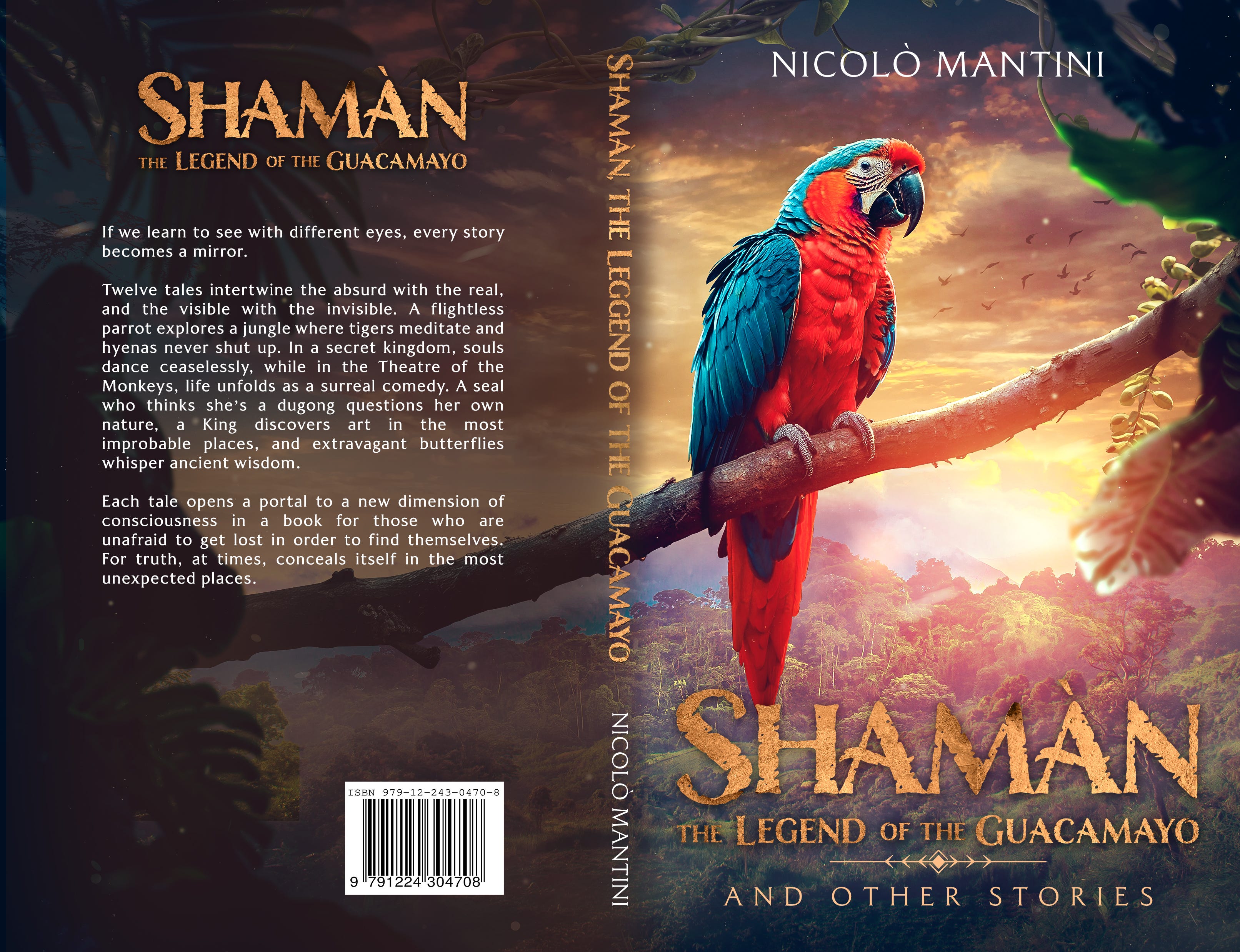
In a remote village, deep in the heart of the Amazon forest, where the trees whisper words and time almost does not exist, I met a remarkable being: a parrot with red and blue feathers who answered to the name of Shamàn.
He was no ordinary parrot. There was something magical in the way he looked at me, as if he could see beyond the surface of things. Yet he carried within himself a mystery: he could not fly.
For weeks, I spent my days watching him, listening to him, and interacting with him. The jungle seemed to fall silent when he appeared. In the hottest hours of the day, Shamàn would pace back and forth, perhaps lost in who knows what thoughts, while I, cradled in my hammock, felt a story growing inside me that yearned to be told.
That’s how I began to write, guided by a mysterious force. The words flowed like a river from a flood, telling of a mystical journey of masters hidden in the jungle and of a quest that grew beyond the simple wish to fly. It was as if the story was writing itself, through me, perhaps imparted through the presence of Shamàn.
I spent a few months in a village hidden among the vines. Then I left and finished writing the story that Shamàn had told me.
Two years later, when I returned to the village, everything had changed. The air was different, charged with a new energy. The inhabitants greeted me with enigmatic smiles and, when I asked about Shamàn, an uneasy silence settled over them.
“Shamàn?” they eventually said. “He found his wings. One morning, just as your story foretold, he soared into the sky and disappeared beyond the clouds.”
I stood there as a shiver ran down my spine. The story I had written, born in the depths of the jungle, had become reality. Or perhaps reality had transformed into a story? I never found out.
I sat on the trunk where Shamàn used to rest, caressing the bark worn smooth by his feet. The wood still bore the marks of his claws, like indelible scars of his pondering.
“There’s more you should know.” A hoarse voice made me turn. It was Wesna, the village Shamàness. She said, “Shamàn isn’t the only one who has changed since you’ve been here.”
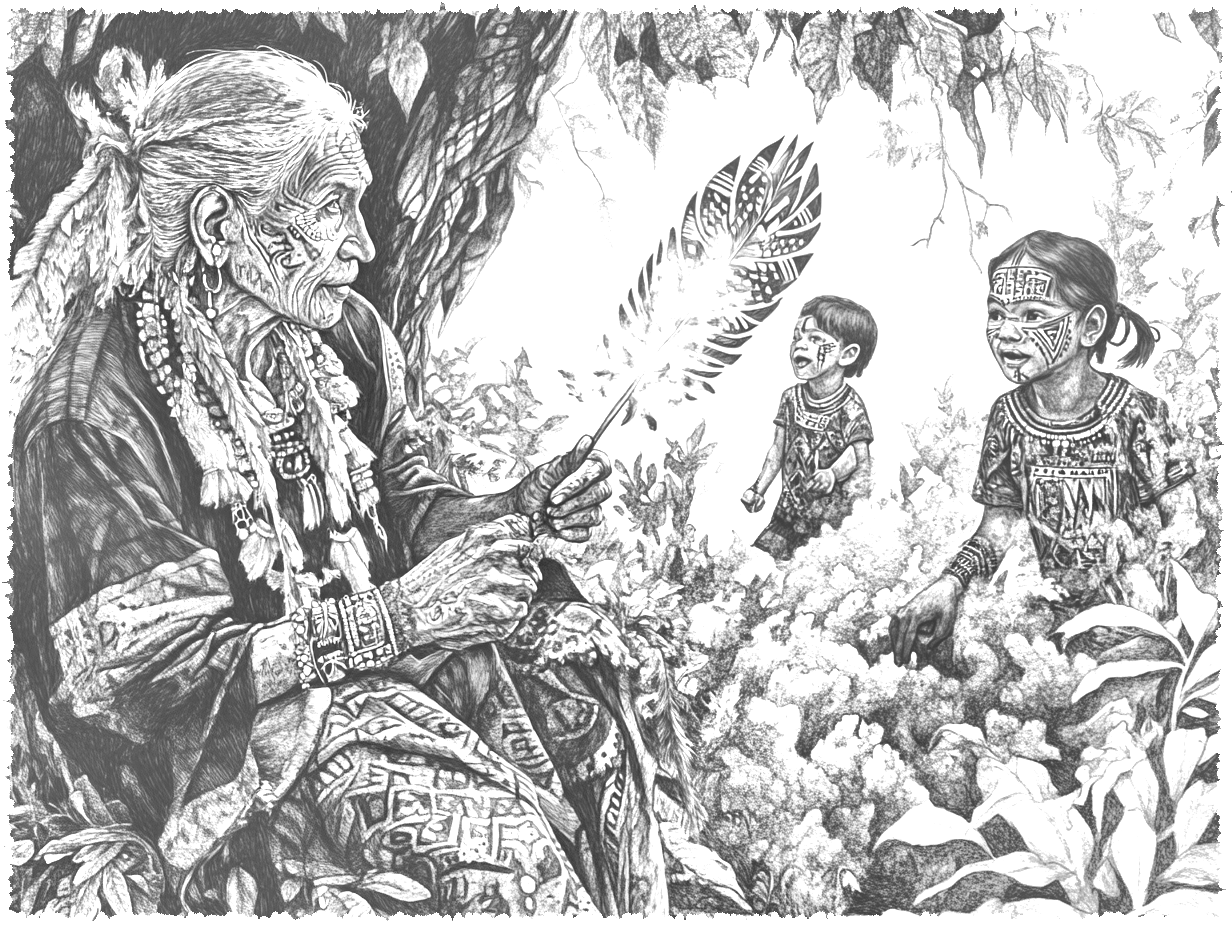
She sat down next to me and took out a small object wrapped in plantain leaves from her burlap bag. She carefully unwrapped it, revealing a feather. It wasn’t just any feather: it was deep red with blue undertones, just like Shamàn’s.
“This one appeared the day after he left. But look closer.”
I took the feather between my fingers. As I looked at it, I noticed tiny symbols forming on its surface—perfect geometric shapes I had never seen before.
“Since that day, the children of the village have begun to dream in a strange language. They draw symbols on the ground, identical to those you see on the feather. And they speak of a place...” Wesna trailed off, peering up at the sky through the thick canopy of trees.
“What kind of place?” I asked.
“They call it ‘The Kingdom of Inīntya’. They say it’s a place where stories come to life, where the boundaries between imagination and reality dissolve.”
A group of children ran past us. The symbols on their faces, painted in natural colours, were the same as those on the feather. They were singing a melody in a language that did not belong to this world, yet it sounded strangely familiar.
“The words you wrote have awakened something ancient, my friend,” Wesna said. “Something that has been sleeping deep in the forest, waiting for the right moment to awaken.”