
The Girl and the Mannequin
A fable about the weight we carry

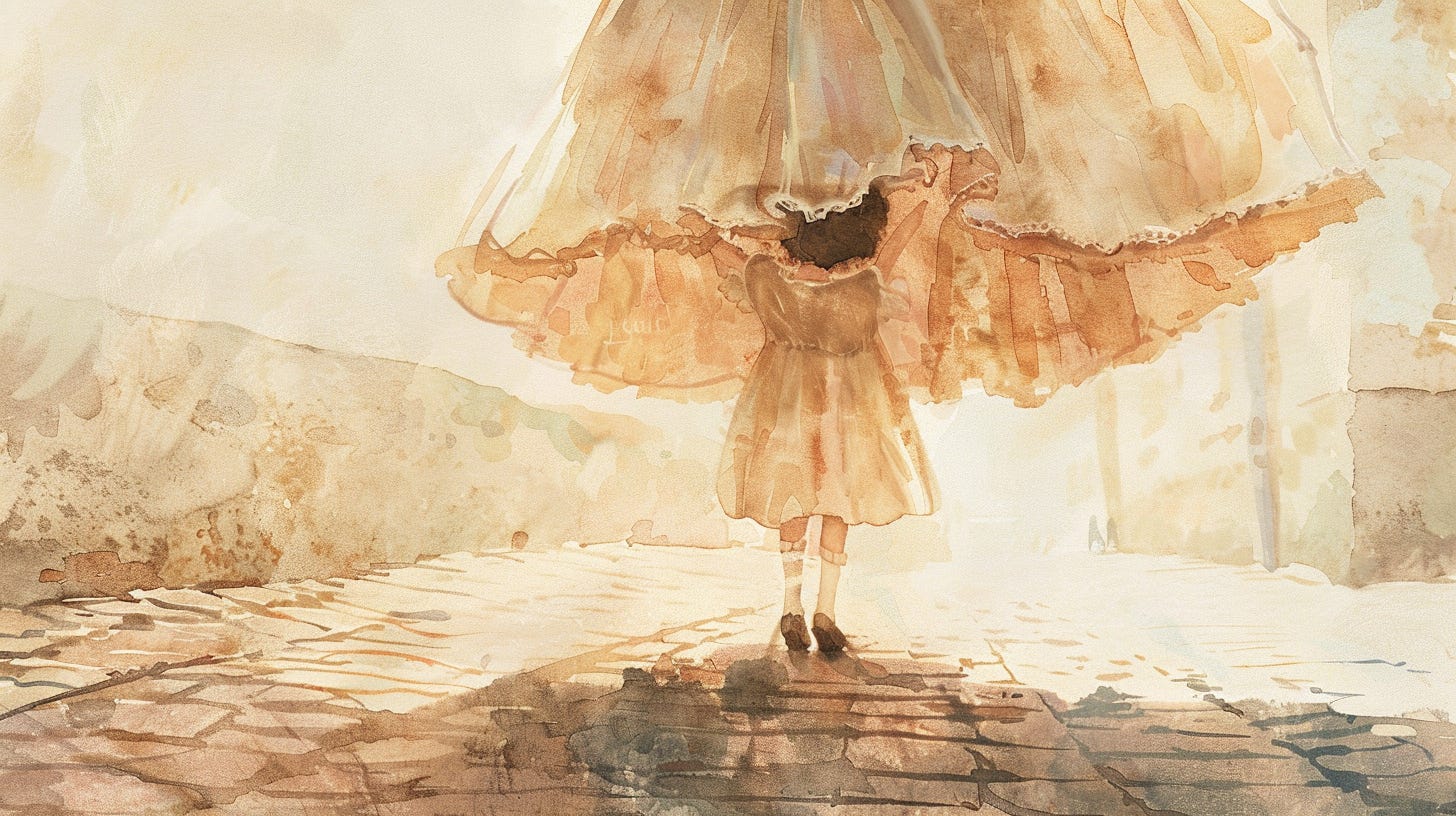
In the town square, between market stalls and coffee shops, walked—or rather, wobbled—an elegant woman in an enormous round skirt. People nodded politely as she passed:
“Good afternoon, madam! Looking splendid today!”
The woman never replied. She couldn’t. She was a mannequin.
And beneath her giant skirt, squeezed between fabric, was a little girl.
She held up the mannequin with all the strength her small shoulders could muster. Every step was agony. Every compliment directed at the “lady’s grace” made her want to scream.
”Yeah, yeah, totally her doing,” she muttered from the darkness. ”Not like I have anything to do with it.”
No one saw her. No one imagined that the perfectly poised woman was just a mannequin.
The Secret Room
Whenever she could, the girl would drag the mannequin into a small room she’d found behind an old building. She’d lock the door, let the mannequin crash to the floor, and collapse against the wall.
“Ahhhh... five minutes of being human, please.”
She’d stare at the lifeless figure lying there—painted eyes, wooden joints, frozen smile—and wonder why nobody else could see how obviously fake it was.
But she knew. People saw what they expected to see. And what they expected was an elegant woman with important business, not an exhausted child playing dress-up with a glorified coat rack.
The Others
Sometimes the girl spotted other adults moving with that same too-smooth grace. When nobody was looking, she’d lift the edge of their coats.
Always, another kid’s tired face peeked out.
”Hi.”
”Hi.”
”How heavy is yours?”
”Forty kilos, I think.”
”Mine’s fifty.”
”My condolences.”
They’d share a brief, weary laugh. But only briefly, because their mannequins always had “important commitments”—like standing still and looking respectable.
The Boy
One day, while the girl wobbled through the square as usual, someone suddenly lifted her skirt.
A face appeared. But this time it wasn’t pale and exhausted—it was a real boy. Free. Eyes bright. Hands empty.
”HEY!” he exclaimed, genuinely shocked. ”What are you doing down there? What IS this? Carnival ended months ago!”
The girl blushed so hard she feared she might spontaneously combust.
”I... uh... I’m escorting my lady?”
”That’s a mannequin.”
”I know.”
”So why are you carrying it around?”
The girl had absolutely no idea.
Panicking, she fled to her room, slammed the door, dropped the mannequin, and leaned against the wall, breathing hard.
Knock knock.
”Hey! I know you’re in there! Come out! Let’s play!”
The free boy didn’t leave. He sat outside her door, talking about games and sunshine and the way it felt to run without carrying anything.
The girl pressed herself against the wall, torn between terror and something that felt dangerously like hope.
The Question
”There are lots of free kids out there,” the boy said through the door. ”They don’t carry anything. They just... play. You could too.”
”I can’t,” she whispered. ”The mannequin has important things to do.”
A pause. Then: ”But what about you? Don’t YOU have important things to do?”
The question hung in the air.
What did she have to do? Hold up the mannequin. Make it look real. Pretend its business was her business.
”You could just... leave it,” the boy suggested. ”It’s not even real.”
”I know it’s not real!” The words burst out before she could stop them. ”But everyone else thinks it is, and if I let go, they’ll see, and—”
She stopped, hearing her own absurdity echoing in the small room.
The mannequin lay on the floor, obviously fake, heavy, and pointless.
And yet she’d been carrying it for years.
The Choice
The boy came back every day, telling stories through the door. About tag and hide-and-seek, about the sun shining, the sunsets over the roofs, and many other adventures.
One afternoon, she finally opened the door.
The boy grinned. ”Want to see something?”
He led her to a window overlooking the square. There, in the golden afternoon light, children played. Real children. Free children. Running and laughing and living without mannequins strapped to their backs.
”See? They’re there every day. And they’d love to meet you.”
The girl watched them closely. Part of her ached to join them. Another part whispered that the mannequin needed her, that she couldn’t just abandon her responsibilities, that…
”I don’t know how to play,” she admitted quietly.
The boy laughed: “That’s impossible! Everyone knows how to play! Anyway, who cares if you’re rusty?” He smiled. ”Being terrible at playing is still better than being great at carrying fake people around.”
Freedom
It took three more days. Then she stepped outside.
”Okay,” she told the boy. ”Let’s play.”
The first time she ran—really ran, without weight—she tripped over her own feet and fell flat on her face. She laughed, surprised by how good it felt.
Her arms still remembered the weight. Her shoulders still ached. But with each game, each moment of ridiculous, pointless joy, the memory faded.
Sometimes she still sees them—the other children carrying mannequins, walking with that too-perfect grace, pretending everything is fine. Her heart breaks for them. She wants to lift every skirt, whisper that they can stop whenever they want.
But she knows better now. You can’t force someone to put down what they’re carrying. They have to realize, on their own, that their arms were meant for better things than holding up illusions.
The mannequin still sits in that room, lying there, so obviously fake that it seems impossible she ever believed in it.
But she did. For years, she gave it her strength, her childhood, her freedom.
Now, when people ask what happened to that elegant woman who used to walk through town, the girl tells them the truth: “She retired. She said something about needing to ‘find herself’…”
The adults nod sympathetically, completely missing the joke.
And then she’s off, sprinting toward the square where the other kids are waiting.
This is beautiful! loved the analogy and loved the image at the end! lets leave the elegant bur heavy mannequin and play :)