There Was Nothing to Forgive
On resentment, mirrors, and the clarity that sets us free.

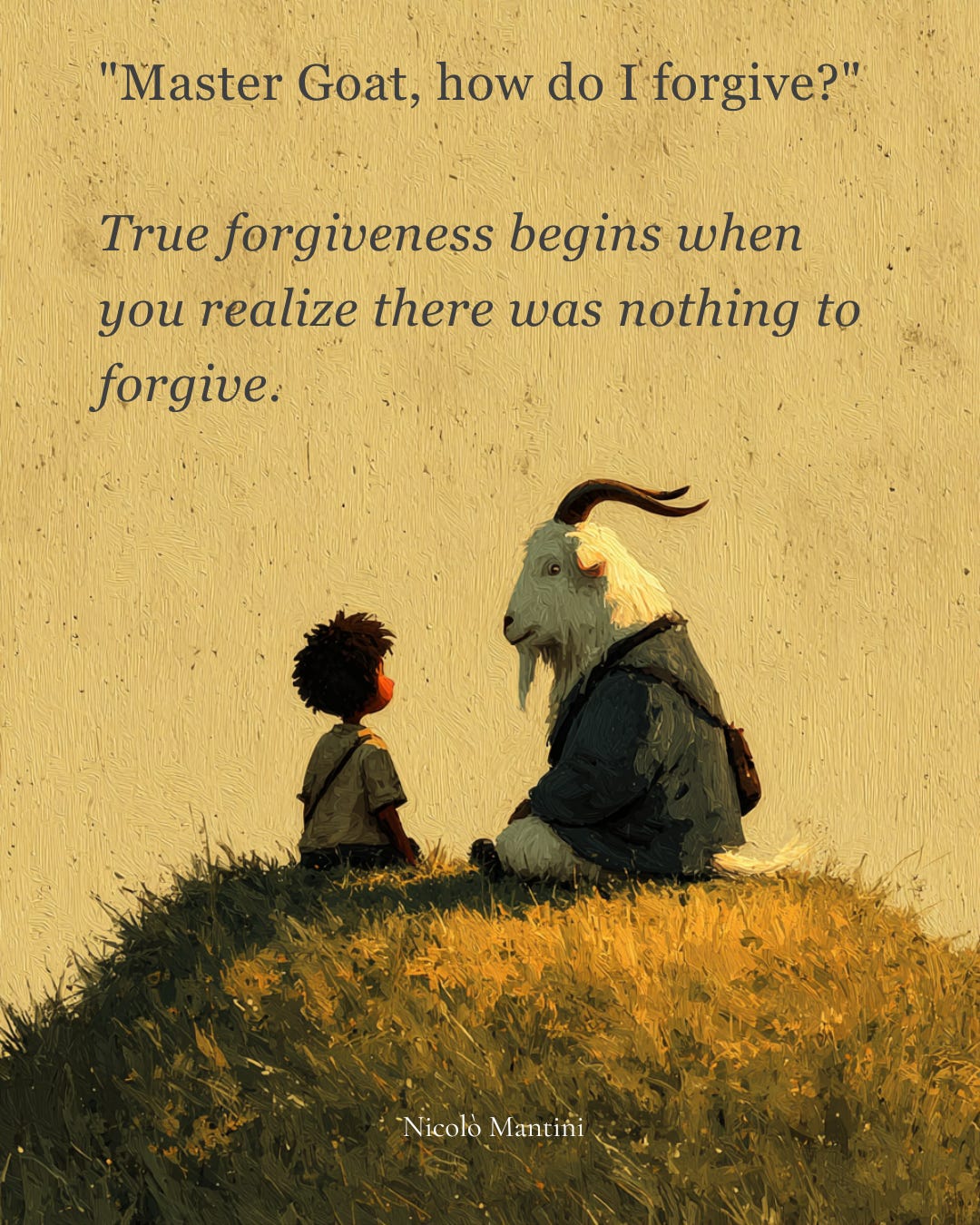
“Master Goat, how do I forgive?" Asked the disciple.
”True forgiveness begins when you realize there was nothing to forgive,” replied master Goat.
There Was Nothing to Forgive
We think we know what forgiveness means.
We think it means accepting what happened. Excusing someone’s behavior. Being the bigger person. Saying it’s fine when it wasn’t fine, or pretending the wound was never there.
And because forgiveness feels like that — like swallowing something that shouldn’t be swallowed — most of us resist it. We hold on to the resentment not out of weakness, but because letting go feels like betraying ourselves.
So we wait. For an apology that may never come. For justice that may never arrive. For the other person to finally understand what they did.
And the wound stays open.
Seeing through different eyes
Something shifts when we begin to understand this: most people who have hurt us were not acting from cruelty. They were acting from pain. From fear. From confusion. From patterns so deep they could not see them, let alone choose otherwise.
To be human is to hurt — and to hurt others — without always knowing it. We do what we can with what we have. No more, no less.
This does not make what they did right. But it makes it human. And when we see it as human — when we recognize in their blindness something of our own — the story begins to change.
The mirror
There is a deeper level to this.
When we look long and honestly enough at the people who have hurt us, something extraordinary begins to happen. The sharp categories of perpetrator and victim — so solid, so certain — start to dissolve.
Every person who has hurt you was a mirror. Not a punishment. A mirror.
They were showing you something. About the patterns you carried. About wounds that were already there. About the level of awareness you were both living from at the time.
That realization does not excuse. It explains. And explanation, when it reaches the heart rather than just the mind, dissolves something that logic alone never could.
When there is nothing left to forgive
True forgiveness is not an act of generosity toward someone who wronged you.
It is an act of clarity.
It arrives not when you decide to let go, but when you see — really see — that everyone in the story, including you, was doing the only thing they knew how to do. That the wound was also a teacher. That the person you most needed to forgive was, in many ways, a reflection of yourself.
When that clarity comes, forgiveness does not feel like a sacrifice.
It feels like a door, opening.
And on the other side, there is nothing left to forgive.
Master Goat said: True forgiveness begins when you realize there was nothing to forgive.